
At the time of writing, EuroAIGuide has no affiliate relationship with ElevenLabs. If that changes, this disclosure changes with it, and this verdict stays exactly as written.
This is general information, not legal advice.
Evidence note: everything below is 🔵, verified against ElevenLabs’ own documentation, privacy policy, DPA and billing pages, except the section marked 🟢, which is first-hand use. Pronunciation quality in specific European languages has not been tested and is explicitly marked as pending.
What ElevenLabs is
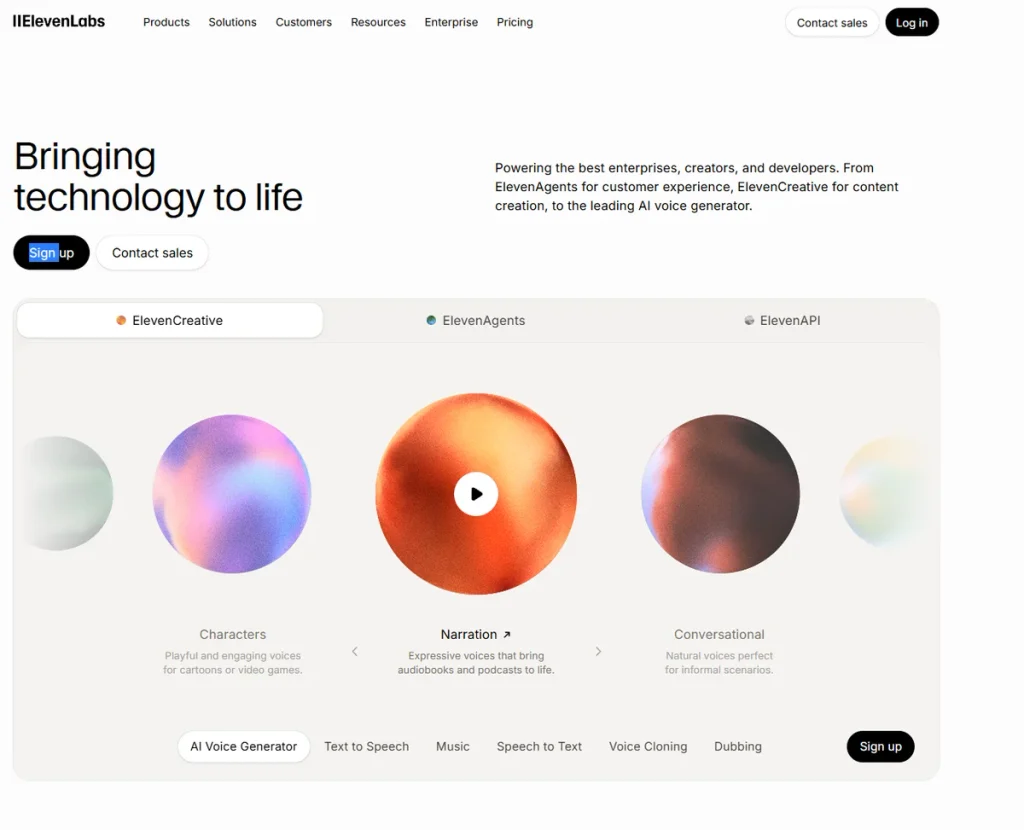
Three products under one roof. ElevenCreative generates speech, music, sound effects and dubbing. ElevenAgents runs conversational voice and chat agents across phone, web, WhatsApp and email. ElevenAPI exposes the text-to-speech, speech-to-text and audio generation engines to developers.
For most European small businesses the relevant part is the first one: turning written text into audio that does not sound like a satnav from 2009.
European language support, model by model 🔵
Founded in 2022 by two Polish entrepreneurs, Mati Staniszewski and Piotr Dąbkowski. ElevenLabs is an American company backed by Sequoia and Andreessen Horowitz.
All 24 official EU languages are covered for text-to-speech and speech-to-text. That is better than almost anything else in this category, and better than the “90+ languages” headline suggests, because which model you use decides what you actually get.
| Language | Eleven v4 | Eleven v3 | Multilingual v2 and Voice Changer | Flash v2.5 (low latency) | Speech to text | Dubbing v2 |
|---|---|---|---|---|---|---|
| Bulgarian | Yes | Yes | Yes | Yes | Excellent | Yes |
| Croatian | Yes | Yes | Yes | Yes | Excellent | Yes |
| Czech | Yes | Yes | Yes | Yes | Excellent | Yes |
| Danish | Yes | Yes | Yes | Yes | Excellent | Yes |
| Dutch | Yes | Yes | Yes | Yes | Excellent | Yes |
| English (UK) | Yes | Yes | Yes | Yes | Excellent | Yes (British) |
| Estonian | Yes | Yes | No | No | Excellent | Yes |
| Finnish | Yes | Yes | Yes | Yes | Excellent | Yes |
| French | Yes | Yes | Yes | Yes | Excellent | Yes (European) |
| German | Yes | Yes | Yes | Yes | Excellent | Yes |
| Greek | Yes | Yes | Yes | Yes | Excellent | Yes |
| Hungarian | Yes | Yes | No | Yes | Excellent | Yes |
| Irish | No | Yes | No | No | Moderate | Unclear |
| Italian | Yes | Yes | Yes | Yes | Excellent | Yes |
| Latvian | Yes | Yes | No | No | Excellent | Yes |
| Lithuanian | Yes | Yes | No | No | High | Yes |
| Maltese | Yes | No | No | No | High | Unclear |
| Polish | Yes | Yes | Yes | Yes | Excellent | Yes |
| Portuguese | Yes (Brazil) | Yes | Yes (PT and BR) | Yes | Excellent | Yes (European) |
| Romanian | Yes | Yes | Yes | Yes | Excellent | Yes |
| Slovak | Yes | Yes | Yes | Yes | Excellent | Yes |
| Slovenian | Yes | Yes | No | No | High | Yes |
| Spanish | Yes (LatAm) | Yes | Yes (ES and MX) | Yes | Excellent | Yes (European) |
| Swedish | Yes | Yes | Yes | Yes | Excellent | Yes |
Speech-to-text tiers are ElevenLabs’ own: Excellent means they claim a word error rate of 5% or under, High means 10% or under, Moderate means up to 50%.
Four things in that table matter more than the row of yeses.
The fast models are where the gaps are. Flash v2.5 and Multilingual v2 are the low-latency models you would actually use for a live phone agent. They skip Estonian, Latvian, Lithuanian, Slovenian, Irish and Maltese. So if you are building a voice agent in Tallinn, Riga, Vilnius, Ljubljana, Dublin or Valletta, the model fast enough to hold a conversation does not speak your language, and the model that speaks your language is not fast enough. That constraint appears nowhere in the marketing.
Irish is the weak point across the board. Not on the flagship v4 model at all, only on v3. Not on any fast model. And speech-to-text sits in the Moderate tier, meaning up to half the words may be wrong. For an official EU language, that is thin.
Maltese exists only on v4. The reverse problem to Irish. One model, no fallback.
Check your European accents before committing. The v4 model lists Portuguese as Brazilian and Spanish as Latin American. Dubbing explicitly offers European French, European Portuguese, European Spanish and British English as dialect options, but the flagship text-to-speech model does not clearly do the same. If you need Lisbon Portuguese or Madrid Spanish rather than São Paulo or Mexico City, test it before you buy rather than assuming.
Outside the official 24, Norwegian, Icelandic, Ukrainian, Catalan, Galician, Welsh, Luxembourgish and Macedonian all appear somewhere in the lineup. Basque and Albanian appear only in Dubbing.
Text to Speech:
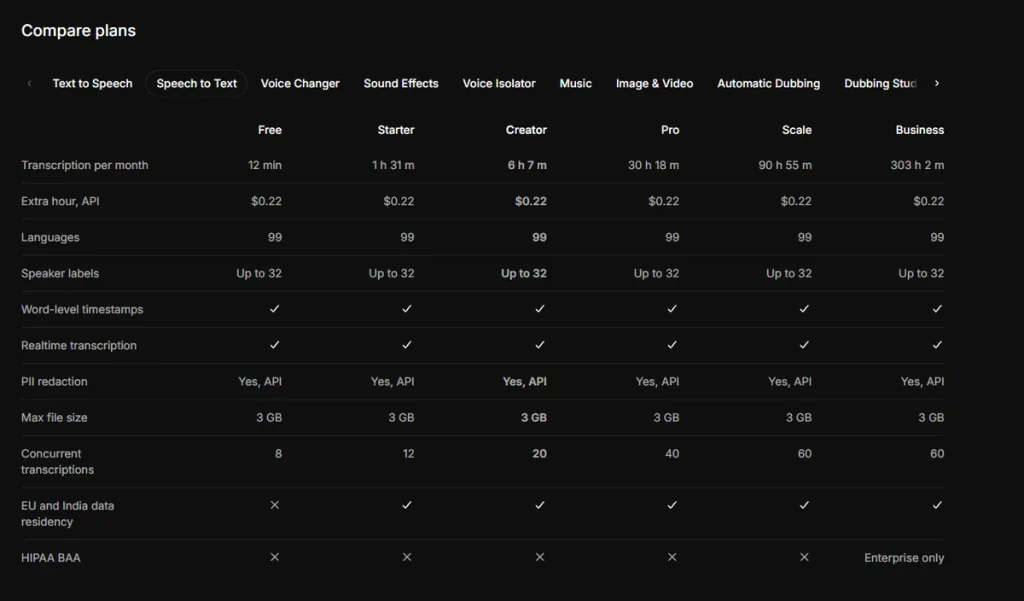
Speech to Text:
What I actually use it for 🟢
I have been using ElevenLabs on my own projects for a while now, across three fairly different jobs.
Narrating videos. This is the main one. I write the script, generate the voice, and drop the audio into the edit. The voice speed is adjustable, which matters more than it sounds: a narration that works for a tutorial is too slow for a short promo, and being able to slow it down or speed it up without regenerating is the difference between one take and six.
Sound effects. You describe what you want and it makes it. There is no library to search through and no licence to check. The only real limit is what you can think to ask for, which is a genuinely strange feeling the first few times.
Small audiobooks. Longer-form narration, where consistency across a whole piece is the thing that usually falls apart in text-to-speech. Here it holds up.
On the voices: the library is large and covers a lot of languages, and you can audition them before committing. If you want a particular kind of voice, it is probably in there somewhere.
My honest opinion after all of that: this is the most authentic-sounding text-to-speech I have used. Not slightly ahead, clearly ahead. If what you need is written text turned into speech that does not announce itself as a machine, I do not think there is a better option available right now.
That is a product judgement, and I want to be clear about what it is not. It is not a judgement about where your data goes, which is covered below and is a separate question with a different answer. The tool being the best in its category and the tool being the right choice for a company that cannot send audio to the United States are two different findings, and both are in this review.
So: I recommend it, with the compliance caveats stated plainly rather than buried. Being American-owned does not make it a worse product. It makes it a product you have to think about before you use it for client work.
One thing I have not tested properly yet: how good any specific European language sounds, judged the way a native speaker would judge it rather than the way a satisfied user would. Everything above is about general quality across the work I do. Those pronunciation tests are still to come, and they get added here when they are done.
Where your audio actually goes 🔵
This is the part that changes the recommendation.
By default, your data is stored in the United States. ElevenLabs’ privacy policy states that it operates servers in the US, the Netherlands and Singapore, and that all personal data will be transferred to the United States for storage. That is the default for every self-serve plan, which is every plan a European small business is realistically buying.
EU data residency exists, and it is Enterprise only. Announced in May 2025, it gives you an isolated EU environment with its own web URL, its own API endpoint at api.eu.residency.elevenlabs.io and its own API keys. You get it by contacting their sales team, not by ticking a box.
Even on EU residency, processing may happen outside the EU. ElevenLabs says so directly in its own documentation: data is stored in your chosen region, but processing may nevertheless occur outside the selected location, including by international affiliates and subprocessors. Zero Retention Mode, also Enterprise or higher API tiers, narrows this further.
Choosing EU residency costs you features. Dubbing is not available in isolated regions, and which language model backs your Agents varies by region. Migration from the standard environment is limited. So the compliance-maximising configuration is also the less capable one, which is a trade-off nobody mentions.
One genuinely good detail, and credit where it is due: Eleven Labs Poland sp. z o.o. in Warsaw is the named data controller for voice data of EEA, UK and Swiss users. An EU-established controller for the most sensitive category of data the product handles is more than most US vendors bother with.
The paperwork: a DPA is available with EU Standard Contractual Clauses governed by Irish law and Irish courts, a UK Addendum, and EU-US Data Privacy Framework certification. SOC 2 Type II report on request. Subprocessors carry general authorisation with 30 days’ notice and a right to object. Voice data is retained for a maximum of three years after last interaction. Self-serve data may be deleted after 180 days of inactivity, and Enterprise data 30 days after termination.
Voice cloning is biometric data, and almost nobody says so
Instant Voice Clone builds a usable copy of a voice from roughly ten seconds of audio. Professional Voice Clone uses thirty minutes or more for a high-fidelity model.
Under GDPR, a voiceprint used to identify a person is biometric data, which falls under Article 9 special categories. That is not a technicality for a European business cloning an employee’s or a client’s voice for marketing. It means you need a lawful basis for processing special category data, documented consent from the person whose voice it is, and in most realistic deployments a data protection impact assessment before you start.
Separately, Article 50 of the EU AI Act took effect on 2 August 2026 and requires that AI-generated or manipulated audio be disclosed as artificial. If you publish synthetic speech to an EU audience, that obligation is yours, not the vendor’s. Our guide to what the AI Act actually changed covers the detail.
And a third layer most people miss: recording law is not harmonised across the EU. If you use ElevenAgents to answer calls or transcribe meetings, the recording itself is governed by national law before GDPR is even reached. Germany is the strict case, where recording the confidential spoken word without consent is a criminal offence under section 201 of the Strafgesetzbuch, not merely a data protection problem. Some member states require all-party consent, others permit one-party. Check your own rule, and check it again if your calls cross borders, which for most readers of this site they do.
All of that sits squarely on you as the controller. ElevenLabs is the processor. No amount of SOC 2 on their side moves that responsibility.
We are not aware of another English-language review of this tool that raises these points.
Who owns it 🔵
Founded in 2022 by two Poles: Mati Staniszewski, the CEO, previously at Palantir, and Piotr Dąbkowski, the CTO, previously at Google. Still private and founder-led.
The corporate shape is more interesting than “American company” suggests. Eleven Labs Inc. is a US corporation registered at a New York address and is the main data controller. The operational headquarters is London. Engineering sits largely in Warsaw. There are further entities in the UK, India, the Middle East and Japan.
The capital is overwhelmingly American. Roughly 781 million dollars raised in primary funding: a16z led the Series A and B, Sequoia co-led the B and led a 500 million dollar Series D in February 2026 at an 11 billion dollar valuation, with ICONIQ, Lightspeed, Bond and others alongside. A September 2026 employee tender offer of 300 million dollars, led by Wellington and T. Rowe Price, valued the company at 22 billion. European and Gulf money appears but in minority positions: EQT from Sweden, Credo Ventures from the Czech Republic, GIC from Singapore, Lunate from Abu Dhabi.
Readers of this site will recognise the shape. European founders, European operational base, American capital, American parent entity. It is the same pattern we found in Pipedrive, Estonian-founded and majority-held by Vista Equity Partners since 2020, and in Sellsy, the French CRM now owned by Italy’s TeamSystem which is itself majority-owned by the US firm Hellman and Friedman. Even Twenty, routinely described as the French open-source CRM, is incorporated in Delaware.
Founded in Europe and owned in Europe are different sentences, and the gap between them is where most of this site’s work happens.
Paying from Europe 🔵
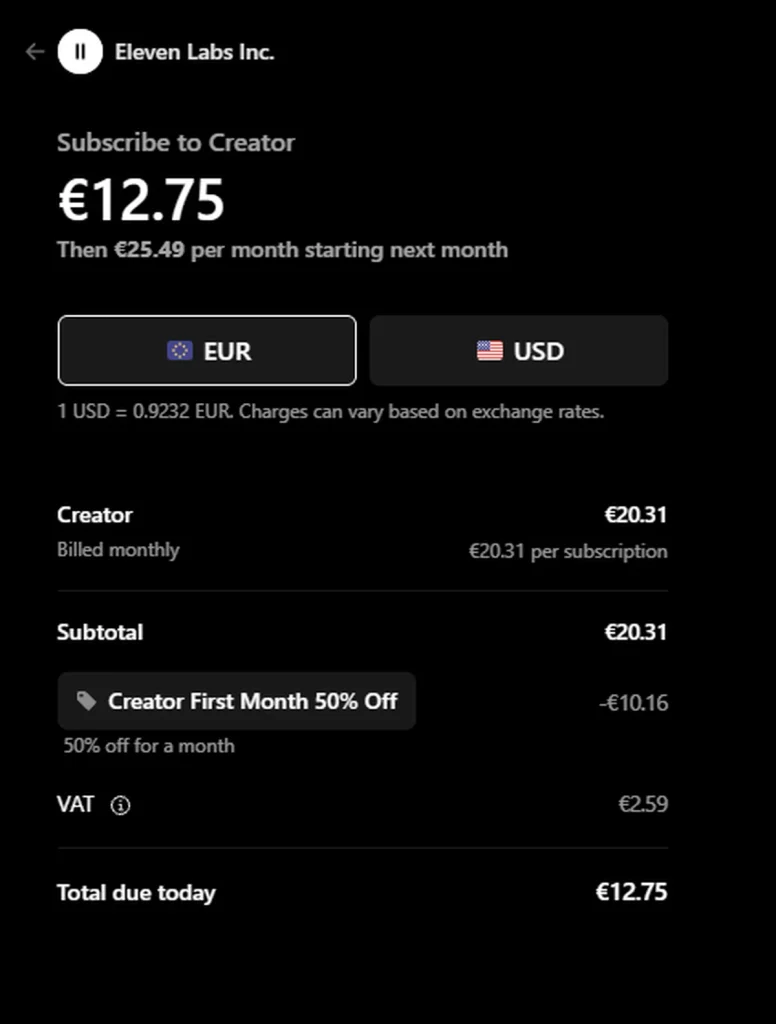
Euro billing is available, which is worth saying plainly because it is unusual in this category. Most of the American AI tools covered on this site quote dollars and leave European buyers to absorb a foreign exchange fee on every invoice. ElevenLabs does not force that.
Payment is by card, Apple Pay or Google Pay, processed through Stripe. Prepaid cards are not officially supported. Prices exclude VAT, and you can add your VAT number under Subscription and then Billing so it appears on invoices, which matters if you are running this through a company.
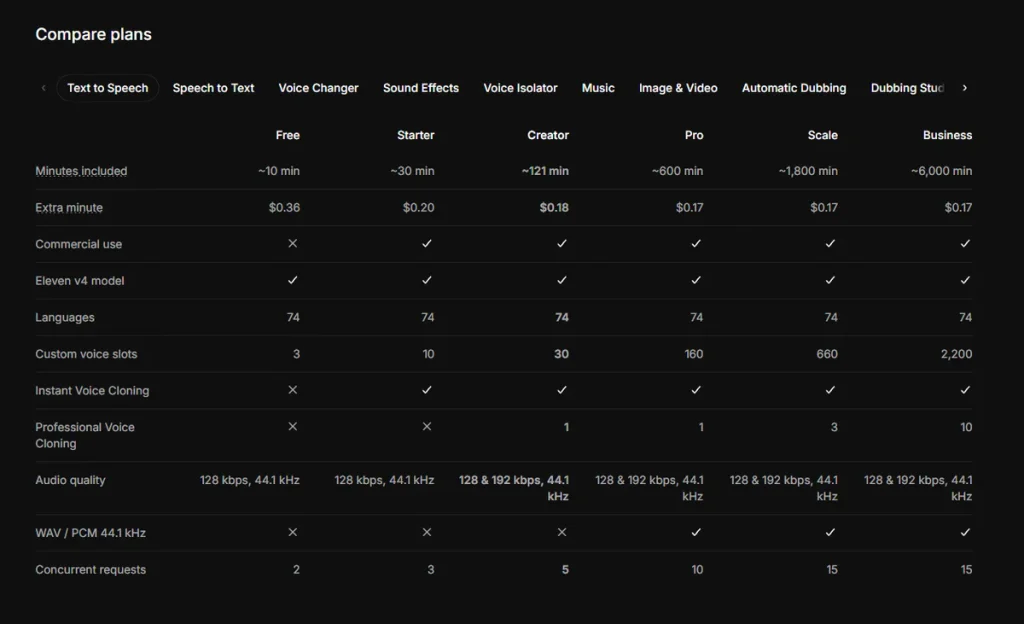
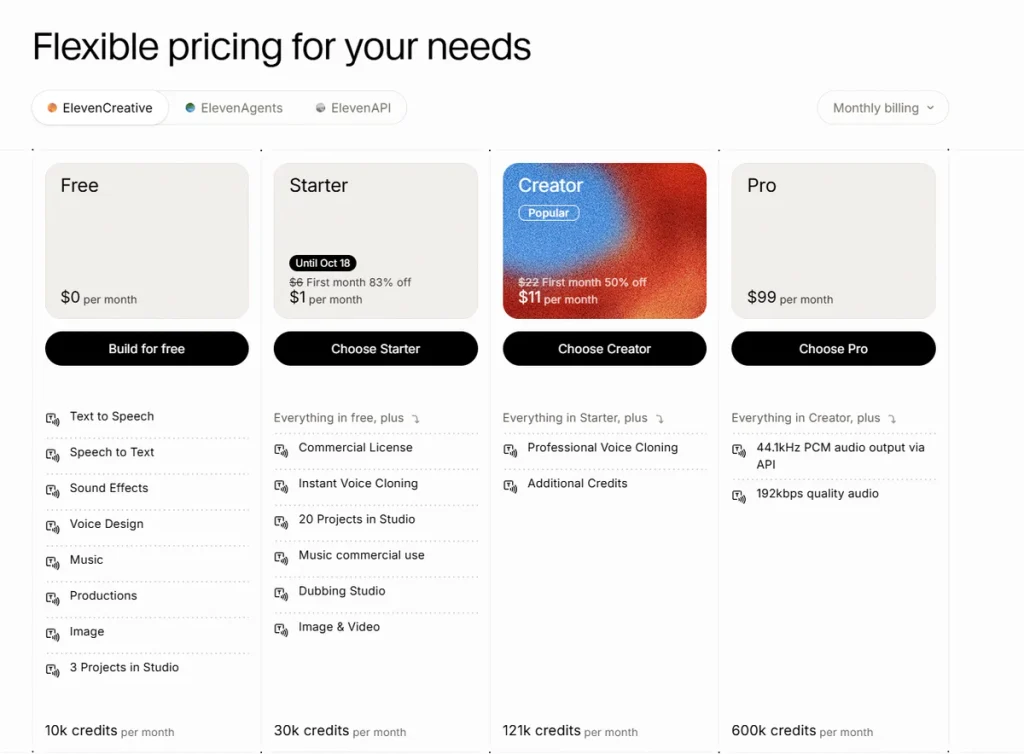
Self-serve plans as of October 2026, listed in USD per month on the public pricing page: Free at 0, Starter advertised at 1 dollar as an introductory offer with the regular price not displayed, Creator at 11, Pro at 99, Scale at 299, Business at 990, and Enterprise on request. Check what the equivalent euro figure is at checkout rather than converting these yourself, since vendors rarely convert at the market rate.
That hidden Starter price is a small irritation worth naming. An introductory rate with no published regular rate means you cannot work out what you will actually pay in month two without signing up.
Euro invoicing or bank transfer may be negotiable on an Enterprise contract. It is not published, so ask.
Pricing in general:
Verdict
If you need European-language audio and compliance is not your binding constraint, ElevenLabs is the most capable option covered on this site. All 24 official EU languages on text-to-speech and speech-to-text, with published accuracy tiers so you can check your own language before buying rather than after. Pending our pronunciation tests, that is a real strength.
If you are building a live voice agent in Estonia, Latvia, Lithuania, Slovenia, Ireland or Malta, check the model table above first. The low-latency models do not cover your language, and that is a product limitation rather than a compliance one.
If your data cannot leave the EEA, this does not work on a self-serve plan. The default is US storage, the EU option is Enterprise only, and even then ElevenLabs tells you processing may happen elsewhere. A German accounting firm or a Dutch healthcare provider handling client audio should read that sentence twice before uploading anything.
If you are cloning anyone’s voice, the GDPR obligations above are yours and they are not small. Get consent in writing, document your lawful basis, and do the impact assessment. The tool makes it technically trivial, which is exactly why the legal part gets skipped.
The honest summary: a very good product, priced sensibly for European buyers, with an EU compliance story that only works if you can afford Enterprise.
Scores
Sovereignty: 4/10 🔵 Based on documentation, which is the only way sovereignty can be assessed.
In favour: an EU-established controller in Warsaw for EEA voice data, EU data residency genuinely available, a proper DPA with SCCs under Irish law, 30 days’ notice on subprocessor changes, Zero Retention Mode, and unusually clear documentation of what the limitations actually are.
Against: default storage in the United States for every plan a small business would buy, EU residency gated behind Enterprise sales, processing that may leave the EU even with residency selected, feature loss when you choose EU residency, a US parent entity with CLOUD Act exposure, ISO 27001 asserted but not verifiable from the primary source, and overwhelmingly American ownership.
Four rather than lower because the EU option exists and is documented honestly, which is more than many vendors offer. Four rather than higher because for the realistic European buyer on a self-serve plan, the answer to “where is my audio stored” is America.
For comparison on this scale: Pipedrive scored 6, where EU signups at least default to Frankfurt or Dublin.
Usability: 10/10 We have used the product extensively and based on my experience, it’s an excellent product, but again this might vary on what languages you need and how well it works for you, but overall it’s an excellent tool, which I can highly recommend.
Sources
All checked 6 and 7 October 2026 unless a page carries its own date.
- Default US storage, server locations, voice data retention, legal entities: elevenlabs.io/privacy-policy
- EU data residency, regions, Enterprise requirement, processing caveat, feature limitations: elevenlabs.io/docs/overview/administration/data-residency
- EU data residency announcement, May 2025: elevenlabs.io/blog/introducing-european-data-residency
- DPA, SCCs under Irish law, UK Addendum, Data Privacy Framework, subprocessor notice, deletion terms: elevenlabs.io/dpa
- Model lineup and per-model language lists: elevenlabs.io/docs/overview/models
- Speech-to-text accuracy tiers: elevenlabs.io/docs/overview/capabilities/speech-to-text
- Dubbing language coverage and dialects: elevenlabs.io/docs/overview/capabilities/dubbing
- Voice Changer language list: elevenlabs.io/docs/overview/capabilities/voice-changer
- Professional voice cloning language coverage: elevenlabs.io/docs/help-center/product/voices/voice-cloning
- Agents language support: elevenlabs.io/docs/agents-platform/customization/language
- Billing currencies and VAT handling: elevenlabs.io/docs/overview/administration/billing
- Payment methods: elevenlabs.io/docs/help-center/account/payment-billing
- Self-serve plan prices: elevenlabs.io/pricing
- Trust Center, where ISO 27001 was not confirmable at time of writing: compliance.elevenlabs.io
- Founders, entities, offices, funding history: en.wikipedia.org/wiki/ElevenLabs
- Series D, 500 million dollars at 11 billion valuation, February 2026: TechCrunch
- Employee tender offer at 22 billion valuation, September 2026: Tech.eu
- EU AI Act Article 50 transparency obligations in force from 2 August 2026: Sidley, Cloud Security Alliance
- GDPR analysis including CLOUD Act and biometric data considerations: compound.law (third party, German law firm)
Keeping this up to date
Pricing, model lineups and language coverage on this product change faster than almost anything else we cover. ElevenLabs shipped a new flagship model and raised twice in the past twelve months.
Last reviewed: 7 October 2026.