

Commercial / Includes affiliate links. At the time of writing, EuroAIGuide has affiliate relationship with Pipedrive. This is general information, not legal advice.
Most CRM reviews are written by people who watched a demo. This one starts with an actual signup, from an EU connection, using a Proton email address, on 29 September 2026.
That last detail turned out to matter more than expected.
What Pipedrive is, in one paragraph
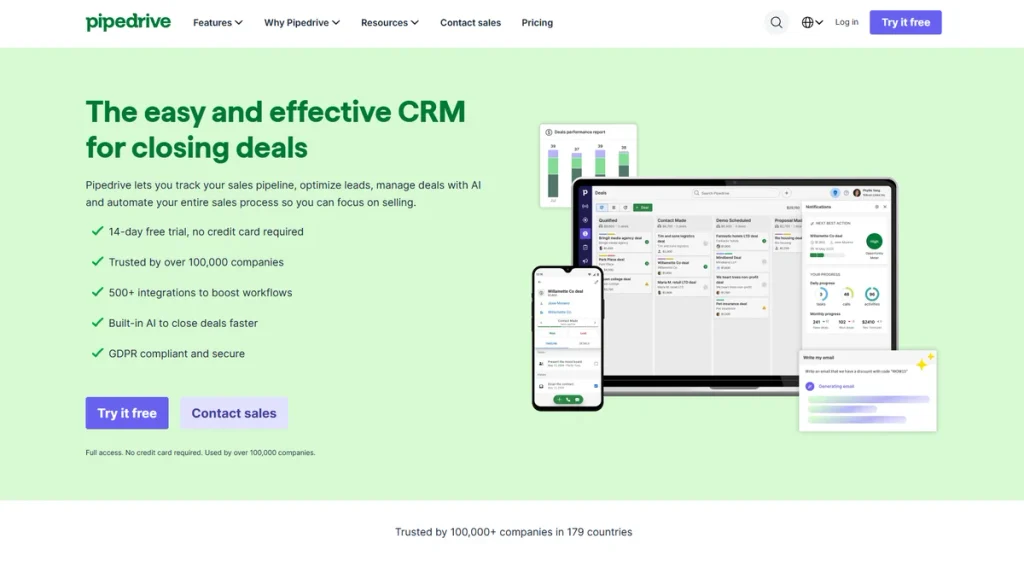
A sales CRM (Customer Relationship Management). It keeps your contacts, the companies they work for, and your open deals in one place, so that a conversation from March is still findable in September. Deals move through a visual pipeline you drag them across. If you currently run your client work out of your inbox and your memory, this is the category of tool that replaces that.
It is not a general business suite. It does sales, and it is unusually focused about it.
Signing up: what actually happened
No credit card required. The 14-day trial asks for nothing payable up front. There is no auto-billing trap waiting at day 15, which is rarer than it should be and worth saying plainly.
A Proton address was accepted. Plenty of B2B(business-to-business) software silently rejects privacy-focused email providers and demands a work email on a company domain. Pipedrive did not. If you run your business on Proton, as a fair number of readers of this site do, you can sign up normally.
A phone number was required. This is the one genuine friction point in the flow. It is personal data collected before you have committed to anything, and there is no clear reason a CRM trial needs it. (The phone number wasn’t ”checked”, so you could get away using a fake one).
Pricing, in euros
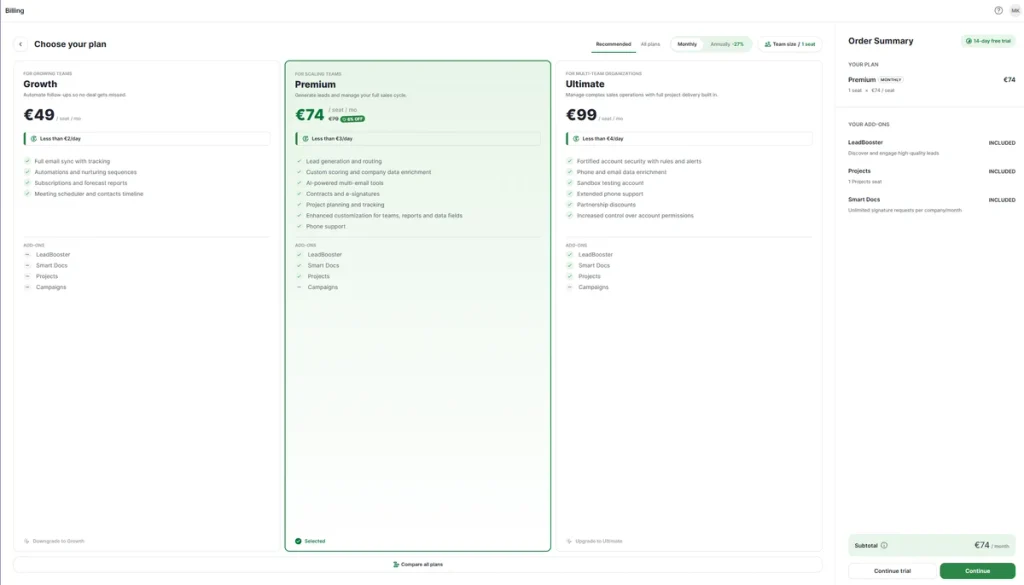
Shown at signup from an EU connection: Growth at 49 euros per user per month, Premium at 74 euros, Ultimate at 99 euros. Monthly pricing is displayed first, with annual billing as the alternative rather than the headline. That is the honest way round, and worth noting because the opposite pattern, advertising the annual rate as if it were the monthly one, is common in this category.
Two caveats on those numbers. Pipedrive’s public pricing pages render currency by IP location, so a reader checking from outside the EU may see US dollar figures instead. And the signup flow showed three tiers while the public pricing page lists four, including a cheaper entry plan. Check both before assuming the signup flow is showing you everything available.
What it is like to use
The contact database splits into People and Organizations, which sounds obvious until you have tried a tool that does not do it. Add a person, link them to a company, and the deal attaches to both. Nothing ends up orphaned.
The list view is genuinely customisable. Columns drag and drop, filters can be private or shared with a team, and saved filters go to a favourites list. Colour-coded labels are editable rather than fixed, which is the sort of small thing that decides whether you actually keep a CRM updated.
Opening a contact gives a split view: static details on the left, a chronological timeline of everything that ever happened on the right. Past emails, calls, notes, attachments. This is the feature that justifies a CRM over a spreadsheet.
Email sync runs one-way or two-way with an external account. There is a map view that plots contacts by their saved addresses. The mobile app covers contacts, activities, and calling or texting directly.
Deals sit on a Kanban board with customisable stages. The platform pushes you to schedule a next activity from the pipeline itself, which is a small piece of behavioural design that works.
Which European languages it actually has
Taken from the interface settings during the trial rather than from a marketing page, Pipedrive offers: Czech, German, English (UK), Spanish (Spain and Latin America), French, Italian, Latvian, Hungarian, Dutch, Polish, Russian and Turkish.
That is a decent spread across Central and Western Europe and covers most of the larger markets. One absence is worth naming, because a feature list that only says “supports 12 languages” will not tell you.
No Portuguese and no Romanian. If you are selling into Portugal or Romania, or employing staff there, your team works in English. Romanian in particular is a sizeable market that most pan-European tools do support.
If interface language is a real constraint for you, check the current settings list yourself before buying. These lists change, and this one was read on 6th of October 2026.
Nova, the AI part
Nova is Pipedrive’s built-in AI meeting assistant, and per Pipedrive it is included on all plans at no extra cost.
Before a call, it assembles a brief from past emails, deal history and previous conversations: summary, flagged risks, recent updates, deal value. During the call it transcribes and pulls out budgets, deadlines and next steps. Afterwards it drafts CRM updates.
Two things about it deserve a European reader’s attention.
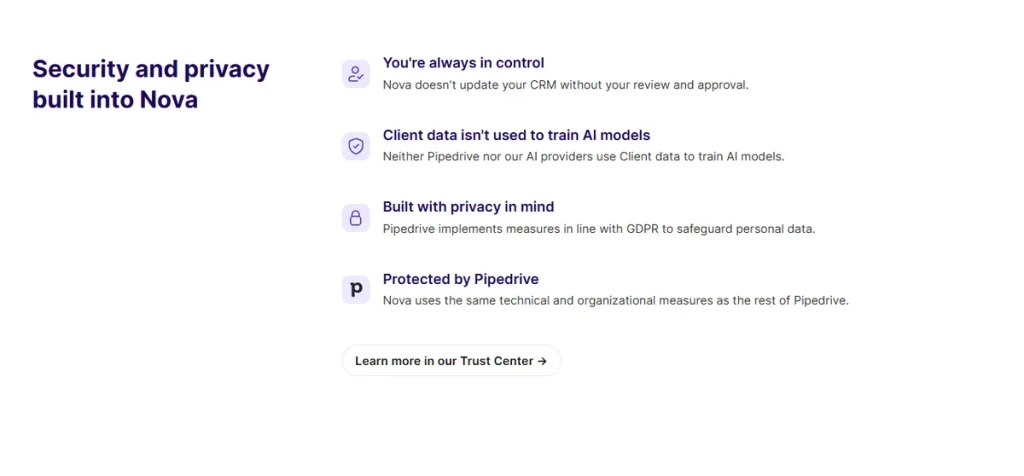
The human stays in the loop by design. Nova’s post-call suggestions do not write themselves into your database. You read them and click to apply. For anyone who has watched an AI tool quietly corrupt a record, that is the right default.
It can run bot-free. You can have Nova join as a visible participant, or run it through a desktop app with no bot in the meeting. The second option deserves scrutiny rather than applause. A recorder that does not appear in the participant list is still recording, and the people on the call may not know it is there.
This is where European readers need to be more careful than the vendor documentation suggests, because recording law is not harmonised across the EU. Germany is the strictest case: recording the confidential spoken word of another person without consent is a criminal offence under section 201 of the Strafgesetzbuch, not merely a data protection problem. Several other member states require all-party consent. Others permit one-party consent. GDPR sits on top of all of it and requires a lawful basis and transparency regardless.
The practical rule is the same everywhere and it is not complicated: if you use the bot-free mode, say out loud that you are recording. Check your own national rule before you rely on anything stronger than that, and check it again if your calls cross borders, which for most readers of this site they do.
Where your data actually sits
This is the part a demo video will not tell you.
Pipedrive runs on AWS, with regional data centres in the EU (Frankfurt, Dublin), the UK, the US, Canada and Australia. EU signups are generally routed to Frankfurt or Dublin, but the subprocessor documentation reads as a default rather than a contractual guarantee, and customers wanting a specific location are pointed to support.
The DPA states personal data may also be processed by Pipedrive affiliates in the US, relying on Standard Contractual Clauses plus self-certification under the EU-US Data Privacy Framework. Certifications held: ISO/IEC 27001:2022, ISO/IEC 27701, SOC 2 Type II and SOC 3.
Which AI vendors touch your data: Pipedrive’s subprocessor list names Anthropic PBC and OpenAI Ireland Limited for AI features, plus AWS and Recall.ai (contracted via Hyperdoc Inc.) for Nova’s meeting capture. Every US-based entry shows Standard Contractual Clauses as the transfer mechanism.
Give Pipedrive credit here. It publishes which model vendors process your customers’ conversations. Most of its competitors say “AI-powered” and leave you guessing. For how this compares across the wider tool landscape, see our guide to AI tools with EU data residency.
Who owns it
Pipedrive was founded in Tallinn in 2010 and is still described everywhere as the Estonian CRM success story. In November 2020 it announced a majority investment from Vista Equity Partners, a US private equity firm, in a deal valuing it at around 1.5 billion dollars. The announcement carries a New York dateline. Earlier investors including Bessemer, Insight, Atomico, DTCP and Rembrandt remained as minority holders.
That position still holds. Pipedrive’s own newsroom describes Vista as majority shareholder in material published in 2026, and no sale, listing or exit has been announced.
This does not put your data outside the EEA, and it is not a reason to avoid the product. But if you chose Pipedrive because you wanted a European company holding your client list, the majority owner sits in the United States, and nothing in the product tells you that.
Estonian-founded and Estonian-owned are different sentences. The same distinction runs through the ChatGPT GDPR question: where the servers are and who controls the company are two separate questions, and only one of them is on the marketing page.
The thing nobody writes about: the integration layer
Pipedrive’s integration list is Slack, Zoom, Gmail, Zapier, Asana, Trello, Microsoft Teams, HubSpot, Intercom, PandaDoc and Google Drive. Almost all American, which is unsurprising since those are the tools most companies already run.
Here is the part worth thinking about. You can host your CRM in Frankfurt, sign a DPA, check the subprocessor list, and then connect Gmail and Slack on your first afternoon and route the same customer data straight into US processing anyway.
The sovereignty question does not stop at the vendor you are evaluating. It follows the data out through every integration you switch on. A CRM with European hosting and eleven American integrations is, in practice, a European front door to an American building.
This is not Pipedrive’s fault, and no CRM in this category is different. But it is the question to ask before you connect anything, and it is the one the vendor comparison charts never include. Our guide to connecting AI tools to your European business stack goes through the same problem across the rest of the toolchain.
What is still untested
In the interest of not overstating what one signup session proves:
- Whether the localised interfaces listed above are complete or partial with English fallbacks. The languages are offered; the quality of each is unverified.
- Whether European diacritics survive into exports, PDFs and outgoing email. This is a real and recurring failure mode in business software, and it affects German, French, Spanish, Polish, Czech, Hungarian and Romanian text differently.
- Whether Nova tells you at the point of use which model vendor is processing your call, or just says “AI”.
- Whether the EU data region can be selected at signup or requires contacting support.
- Where in the flow a DPA is offered, and whether it is self-serve.
- How data export and cancellation work.
- Whether Pipedrive integrates with national e-invoicing systems and local accounting software, which for most European SMEs matters more day to day than anything above.
These are the next test session, and this article gets updated when they are answered.
Scores
Usability: 9/10. Based on hands-on use during the trial. No credit card demanded, a Proton address accepted without argument, euros shown monthly-first, a coherent People and Organizations model that keeps nothing orphaned, genuinely customisable views, and Nova’s approve-before-applying default. The phone number requirement is the only real friction in the flow. No localised interface has been quality-checked yet, and this score will be revised if any turns out to be partial.
Sovereignty: 5/10. Based on vendor documentation, not the trial. Sovereignty is documentary by nature and cannot be tested by using a product.
Points in favour: Estonian-founded, EU hosting in Frankfurt and Dublin for EU signups, an unusually honest subprocessor list that names the AI vendors by company and legal entity, and a full certification set.
Points against: majority-owned by a US private equity firm, EU hosting that reads as a default rather than a contractual guarantee, transfers relying on Standard Contractual Clauses and Data Privacy Framework self-certification, and an integration ecosystem that is almost entirely American.
Six rather than higher because ownership is American and the EEA is not contractually guaranteed. Six rather than lower because Pipedrive publishes what most of its competitors bury, and transparency is worth something on its own. Tools with genuinely European ownership, such as a founder-owned or non-profit-controlled company with contractual EU-only processing, score higher on this scale.
How these scores work: the two numbers come from different evidence. Usability is earned in the product, during real use. Sovereignty is read off vendor documentation, because that is the only place it exists. See our How We Test page for the full rubric.
Verdict
For a European small business or consultant who currently runs sales out of an inbox, Pipedrive is a straightforward recommend on the product itself. The trial is honest, with no card and no auto-bill, pricing is shown in euros and monthly-first, the interface is genuinely pleasant, and Nova’s approve-before-applying default is the right one.
On sovereignty the answer is more nuanced than the Estonian branding suggests. Data is generally EU-hosted but not contractually EU-only. Ownership is American. AI processing runs through named US and Irish vendors, disclosed properly. And the integration layer will take your data to the US the moment you connect the tools you actually want.
If your requirement is that customer data must never leave the EEA, contractually, this is not that product, and you should be looking at European-owned or self-hosted options instead.
If your requirement is European hosting, honest disclosure, and knowing what you are agreeing to, Pipedrive holds up better than most, largely because it publishes the things its competitors hide.
Sources
- Hands-on signup and trial, Finnish connection, 29 September 2026
- Pipedrive subprocessor list (AWS regions, Anthropic PBC, OpenAI Ireland Limited, Recall.ai via Hyperdoc Inc.): pipedrive.com/en/subprocessors, page last updated 13 July 2026
- Pipedrive DPA and EU-US Data Privacy Framework participation: pipedrive.com/en/privacy/dpa
- Certifications (ISO/IEC 27001:2022, ISO/IEC 27701, SOC 2 Type II, SOC 3): trustcenter.pipedrive.com
- Finnish interface listed as supported: pipedrive.com/en/features/multilingual-multi-currency
- Vista Equity Partners majority investment, November 2020: pipedrive.com newsroom
- Deal valuation approximately USD 1.5 billion: PitchBook
All checked 29 September 2026 unless a page carries its own update date.
Keeping this up to date
Ownership, pricing and subprocessor lists change. This page is reviewed on a short cycle, and the untested items above are scheduled for a second session before the trial ends.