

- The one distinction that changes everything
- Where your data actually goes
- Location is not the whole story: the CLOUD Act
- A clarification: "high-risk" under the AI Act is a different question
- This is not hypothetical: the regulators have already acted
- So, can you actually use it?
- How to use ChatGPT compliantly, in practice
- Frequently asked questions
- The honest summary
- Sources
If you run a business in Europe and you have started using ChatGPT for work, a quiet worry probably followed close behind: am I allowed to do this? Every time you paste in a customer email or a spreadsheet of names, a small voice asks whether you have just done something GDPR would frown on.
Most people land on one of two wrong beliefs. Either “AI tools are basically banned under GDPR,” which is false and would cut you off from useful tools for no reason, or “everyone uses ChatGPT, it must be fine,” which is also false and can quietly put you at real risk. The real answer is more specific than either, and it is not complicated once you can see it.
This guide explains, in plain terms, when ChatGPT is safe to use for a European business, when it is not, and exactly what to check. No legal background needed.
Is ChatGPT GDPR Compliant?
The short answer Yes, with one condition that does most of the work. For general work with no personal data in it, use ChatGPT on any plan, including free. The moment you put customers’ or employees’ personal data in, you need a Business or Enterprise plan, because those come with a no-training default and the data-processing agreement GDPR expects. Free and Plus do not, and that is where most European businesses are quietly getting this wrong. If your data must stay in the EU, that is Enterprise only. If your data is genuinely sensitive (health, legal, defence, regulated finance), a US-owned tool is the wrong home for it regardless of plan, and an EU-native model like Mistral is the better answer for that work.
This is general information, not legal advice.
The one distinction that changes everything
There is a single fact that decides most of this, and it is the thing people miss: OpenAI treats its consumer plans and its business plans completely differently when it comes to your data.
On the individual plans (Free, Go, Plus, and Pro), your conversations are used by default to help train OpenAI’s future models. You can turn this off in the settings, but it is on unless you do. More importantly, there is no formal data agreement between you and OpenAI on these tiers, because you are using the tool as an individual consumer, not as a business handing data to a processor.
On the business plans (ChatGPT Business, formerly called Team, and ChatGPT Enterprise), the opposite is true on both counts. Your data is not used for training by default, no opt-out required, and OpenAI provides a proper data-processing agreement built for GDPR. Enterprise adds more on top, including the ability to keep data in a specific region and stronger admin controls. The API works the same way, with no training on your data by default plus strict retention controls, for businesses building ChatGPT into their own systems rather than using it in a browser.
That second point deserves a moment, because it is the one people underrate. GDPR expects that when another company processes personal data on your behalf, you have a data-processing agreement with them, usually called a DPA, setting out what they can and cannot do with it. It is not optional paperwork, it is a core requirement. So the consumer tiers do not fall short merely because of the training. They fall short because there is no DPA to rely on at all.
That difference is the whole ball game. It means the exact same action, pasting a customer list into ChatGPT, can be broadly fine on one plan and a genuine GDPR problem on another.
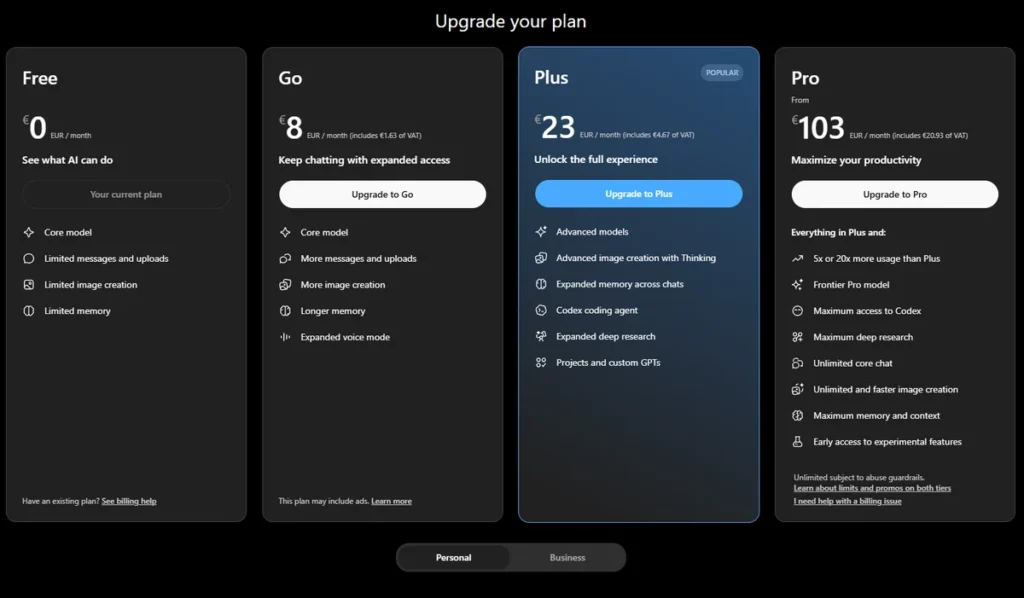
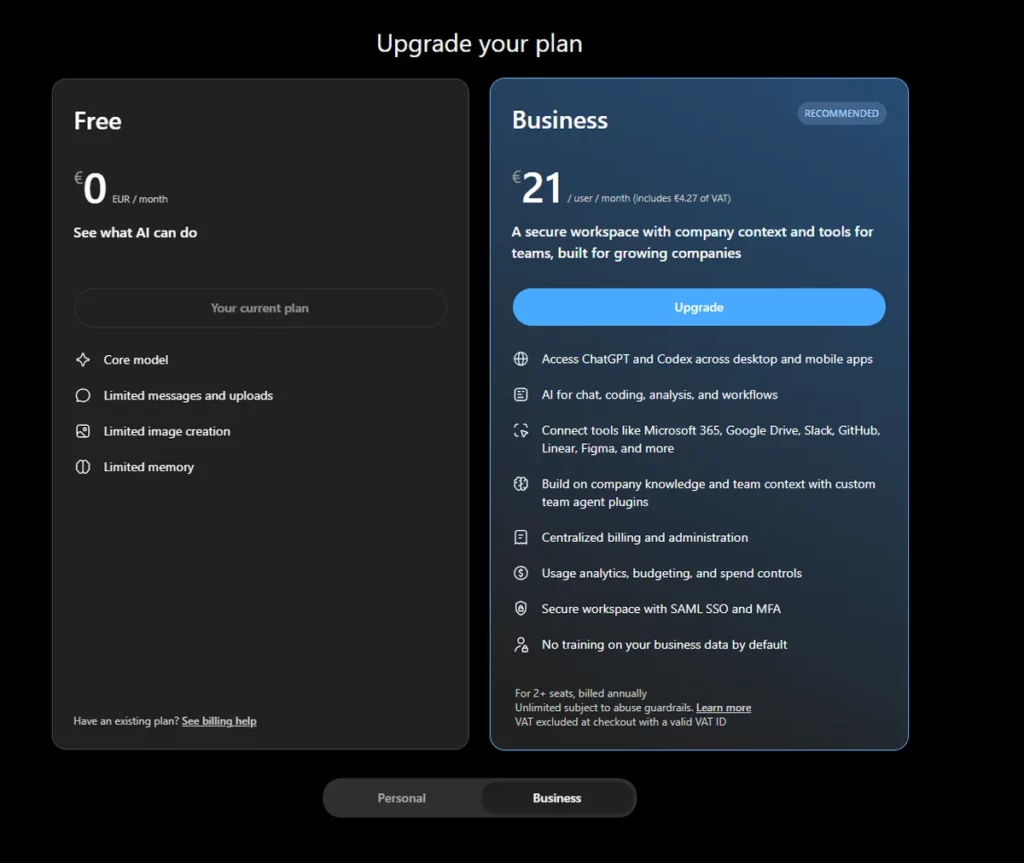
Current Prices for the ChatGPT:
Free version available.
Go: 8€.
Plus: 23€.
Pro: 103€.
Business: Starting from 21€. No training on data by default.
Where your data actually goes
There is one more piece: location. GDPR cares about where personal data is processed and whether it leaves the EU.
By default, ChatGPT processes your data on OpenAI’s infrastructure, which is primarily in the United States. For general, non-personal use that is nothing to worry about. But for personal data, sending it to the US is a cross-border transfer, which is exactly the kind of thing GDPR asks you to account for.
If keeping data inside the EU is a hard requirement for you, that is available, but only on the Enterprise tier, which offers data residency in specific regions including the EU. The consumer and standard business tiers do not let you pin processing to Europe. So if EU data residency is non-negotiable for your organisation, Enterprise is the tier where that becomes possible. For the wider view of which AI tools keep data in the EU, see our guide to AI tools with EU data residency.
Location is not the whole story: the CLOUD Act
Here is a subtlety that matters enormously for sensitive data, and that most guides skip. Choosing EU data residency puts your data on European servers, but it does not, on its own, put it beyond the reach of US authorities. The reason is a US law called the CLOUD Act.
The CLOUD Act (2018) lets US authorities compel US-based companies to hand over data they control, even when that data sits on servers outside the United States. Because OpenAI is a US company, it falls under this law wherever its servers physically are. So a European data centre changes the geography, but not the jurisdiction. (The Patriot Act and FISA belong to the same family of US powers, which is why you may have heard this concern framed in those terms.)
This creates a real tension with GDPR. Under GDPR Article 48, a foreign court order is not, by itself, a lawful basis for handing over European personal data. There is meant to be a proper international agreement in place. So a US provider served with a CLOUD Act demand is caught between two laws pulling in opposite directions, and European data protection authorities have flagged this openly. It is one of the reasons the whole “is US cloud safe for EU data” question has never been fully settled.
For most businesses doing ordinary work, this is a background risk rather than a daily one. The chance of any specific company’s data being pulled by a US authority is low, and a business tier plan, a data agreement, sensible limits on what you enter, and EU residency together make a reasonable, defensible posture. Do not let this section scare you off using AI at all. But the calculation shifts as your data gets more sensitive, and that is the real answer to the high-risk question.
A clarification: “high-risk” under the AI Act is a different question
Two separate ideas get tangled here, and they are worth pulling apart before the verdict below. Being in a “high-risk” category under the EU AI Act (recruitment, credit scoring, medical, biometrics, and so on) is not the same thing as the CLOUD Act question. The AI Act’s high-risk rules are obligations on you, the organisation using the AI: risk assessments, human oversight, record-keeping. They do not, in themselves, forbid you from using American software. So “we are high-risk under the AI Act, therefore we cannot touch ChatGPT” is not right as a matter of law. The two are different concerns that happen to point at the same caution.
What should actually drive your decision is the sensitivity of your data, not your regulatory label. That is a sliding scale rather than an on-off switch, and the verdict below sets out where the lines fall.
This is not hypothetical: the regulators have already acted
If you are tempted to think GDPR enforcement against AI tools is a distant, theoretical risk, it is worth knowing it has already happened. In 2023, Italy’s data protection authority temporarily blocked ChatGPT in the country over GDPR concerns. OpenAI had to respond by adding privacy disclosures, an age-verification step, and the tool that lets users opt out of having their conversations used for training, before the service was allowed back.
The lesson for a European business is simple: EU data protection authorities can and do act on AI tools under existing law, without waiting for the EU AI Act. So “everyone uses it, it must be fine” is not the safety net people assume. Using these tools thoughtfully is the actual safety net. For how the AI Act adds to this picture, see our guide to what the EU AI Act means for your business.
So, can you actually use it?
“Is ChatGPT GDPR compliant?” is the question everyone types in, but it is the wrong question, and that is why nobody gives you a straight answer to it. ChatGPT is not compliant or non-compliant any more than a filing cabinet is. What you actually want to know is whether you can use it. That question does have a straight answer. Find your case below.
You are using it for general work, with no personal data involved. Drafting text, brainstorming, summarising public documents, writing code. Yes, use it. Any tier, including free. There is no personal data being processed, so most of GDPR simply does not engage. Turn off training if you would rather your work not feed the model, but that is a preference, not a compliance issue.
You are putting customer or employee personal data into it. Names, emails, client details, support tickets, CVs. Yes, but only on Business or Enterprise, with the data-processing agreement in place. On Free or Plus the answer is a firm no, and that is the single most common mistake European businesses are making with this tool right now. The business tier is not a nice-to-have here, it is the thing that makes the processing defensible.
Your organisation requires personal data to stay inside the EU. Yes, but only on Enterprise. It is the one tier that lets you pin processing to a European region. If someone has told you the standard business plan can do this, they are wrong. Note also that this solves the location question, not the jurisdiction one, which is the next case.
You handle genuinely sensitive data, or work in a high-stakes sector. Health records, legal case files, defence, government, regulated finance. For that data, no. Not because GDPR forbids it, but because OpenAI is a US company and the CLOUD Act reaches its data wherever the servers sit. Many European organisations look at that and reasonably decide a US tool is not the right home for their most sensitive material. The answer is not to abandon AI, it is to use an EU-native model such as Mistral, a French company outside US jurisdiction, or self-host an open model on your own infrastructure for that slice of work, and use ChatGPT for everything else, per the cases above. Our EU data residency guide covers which tools keep data under European control. Almost no organisation is case four for all of its work.
The pattern across all four: the more personal or sensitive the data, the more the plan and the jurisdiction matter. Most European businesses are case one and case two, and for both of those, ChatGPT is a legitimate tool used by plenty of serious companies. Case four is real but narrow, and it applies to specific data, not to your whole organisation.
None of this is unique to ChatGPT, incidentally. Claude and Gemini raise the same three questions, which plan you are on, whether your chats train the model, and where the processing happens, and they answer them differently. If you are still deciding which assistant to standardise on, our comparison of ChatGPT, Claude and Gemini for European users works through each of them.
One thing no case above removes: even on the best plan, GDPR compliance is never something the software does for you. You still need a lawful reason to process the data, you still need to handle it proportionately, and you still should not feed a tool more personal data than the task requires. The plan choice removes the biggest obstacles. It does not remove your responsibility.
How to use ChatGPT compliantly, in practice
A short, practical checklist for a European business:
- Match the plan to the data. Non-personal work is fine on any tier. For anything involving customers’ or employees’ personal data, use Business or Enterprise, not Free or Plus.
- On consumer tiers, turn off training at minimum. In settings, disable the use of your chats for model training. It does not give you a DPA, but it is the baseline if you are on Plus.
- Get the data-processing agreement. On a business tier, make sure the DPA is in place. It is the contract GDPR expects.
- Consider where the data sits. If EU data residency is a hard requirement for you, that is an Enterprise feature. Otherwise, be aware personal data is processed outside the EU.
- Put in less than you think you need. The safest personal data is the data you never entered. Strip out names and identifiers where the task does not truly need them.
- Have a lawful basis and a light internal note. Know why you are allowed to process the data, and jot down which tools your team uses and what not to put in them. This also covers the AI Act’s literacy expectation.
Do those, and you can use ChatGPT across most of your business with confidence rather than a nagging worry.
Frequently asked questions
Is ChatGPT GDPR compliant? It can be used compliantly, but it is not automatically compliant. On business tiers (Business or Enterprise) you get no training on your data by default and a data-processing agreement, which is what GDPR expects. On free and Plus tiers, your chats may train the model unless you opt out, and there is no data agreement, so those are not suitable for personal data.
Can I put customer or personal data into ChatGPT? Only on a business tier with a data-processing agreement in place, and even then, only as much as the task genuinely needs. Do not put personal data into the free or Plus consumer plans.
Does ChatGPT train on my conversations? On the individual plans (Free, Plus, Pro) it does by default, unless you opt out in settings. On Business, Enterprise, and the API, it does not train on your data by default.
Can I keep my data in the EU with ChatGPT? EU data residency is available, but only on the Enterprise tier. The consumer and standard business plans process data on OpenAI’s infrastructure, which is mainly in the US.
Is the free version of ChatGPT safe for business use? For general, non-personal work, yes. For anything involving personal data, no, because your chats may be used for training unless you opt out, and there is no data-processing agreement. Move to a business tier for that.
Does using a business plan make me automatically compliant? No. It removes the biggest obstacles (training and the missing agreement), but you still need a lawful basis, sensible data handling, and control over what you enter. The tool provides the foundation, not the whole of compliance.
The honest summary
ChatGPT is not banned under GDPR and it is not a free-for-all. Match the plan to the data, keep genuinely sensitive material out of a US-owned tool, and put in less than you think you need. The tool gives you a compliant foundation. It never does the compliance for you.
Sources
- On individual plans (Free, Plus, Pro) ChatGPT may use conversations for training unless you opt out; business users (Team/Business, Enterprise, API) are not trained on by default. OpenAI, How your data is used to improve model performance: https://openai.com/policies/how-your-data-is-used-to-improve-model-performance/
- Business and Enterprise plans exclude data from training by default and include a GDPR-aligned data-processing agreement; Enterprise offers regional data residency. OpenAI, Enterprise privacy: https://openai.com/enterprise-privacy/
- Italy’s data protection authority temporarily blocked ChatGPT in 2023 over GDPR concerns, requiring privacy disclosures, age verification, and a training opt-out before restoring access. (Italian DPA): https://www.garanteprivacy.it/
- The US CLOUD Act can require US-based providers to disclose data they control regardless of where it is stored, which conflicts with GDPR Article 48; a foreign authority’s request is not by itself a lawful basis for transfer. European Data Protection Board and European Data Protection Supervisor, Joint response on the US CLOUD Act: https://www.edpb.europa.eu/system/files/documents/files/file2/edpb_edps_joint_response_us_cloudact_annex.pdf
Last reviewed July 2026. OpenAI’s plans and data terms change; we verify these against OpenAI’s own policy pages and update as needed. This article is general information, not legal advice.