
Affiliate disclosure: Some links here may be affiliate links, meaning we may earn a commission if you sign up through them. It never changes our verdict, and our scores are based on our own testing.
- How we tested
- Finding 1: for translation, they are all frighteningly good
- Finding 2: short original writing is great too
- Finding 3: push it long, and they fall apart differently
- The real deciding factor: where does your text go?
- One important clarification: DeepL translates, it does not write
- The tools, scored
- At a glance
- So which should you choose?
- Frequently asked questions
- The honest summary
- Sources
We hear the same question a lot from European readers: which AI is actually best for translating and writing in our languages, and can I trust it with text that is not in English? So we sat down and tested it properly, not with a marketing checklist, but by running real text through each tool and reading the results with a native eye.
AI Translation for European Languages:
We tested four tools that people actually reach for: DeepL, ChatGPT, Gemini, and Mistral. We ran them through four escalating stages, from a few sentences up to a prompt generated 2500-word piece, across several European languages. What we found was genuinely interesting, and it changes the advice we would give.
The short version
- Translation is basically solved(especially for simple text). All four tools translated European languages so well that, for everyday text, you can pick any of them on quality alone. The differences were tiny and the text was 90-95% good.
- Because quality is a tie, the real question is where your data goes. For anything with personal or business information in it, that points to the European options: Mistral (EU by default) and DeepL (German, strong data posture).
- Writing original text is a different story. Short pieces were great from all of them. But when we pushed to a long 2500-word piece, they separated sharply, and one fell down badly.
How we tested
We wanted to test two different jobs, because they are not the same thing. Translation means taking text that already exists and converting it to another language. Generation means asking the AI to write original text from a prompt. We ran four stages, getting harder each time:
- Translation, a few sentences. The basic case.
- Translation, around 1000 words. Does quality hold up over length?
- Generation, a 250-word piece from a prompt. Can it write naturally from scratch?
- Generation, a 2500-word piece from a prompt. What happens when you really push it?
We judged the output the way a real user would: does it sound natural, is the grammar right in the tricky parts (Finnish cases, German compound words, and so on), and does it read like a person wrote it. This is an honest hands-on test from a European user, not a laboratory benchmark. Your results may vary by language and by task, which is exactly why we tell you to test your own text too.
Finding 1: for translation, they are all frighteningly good
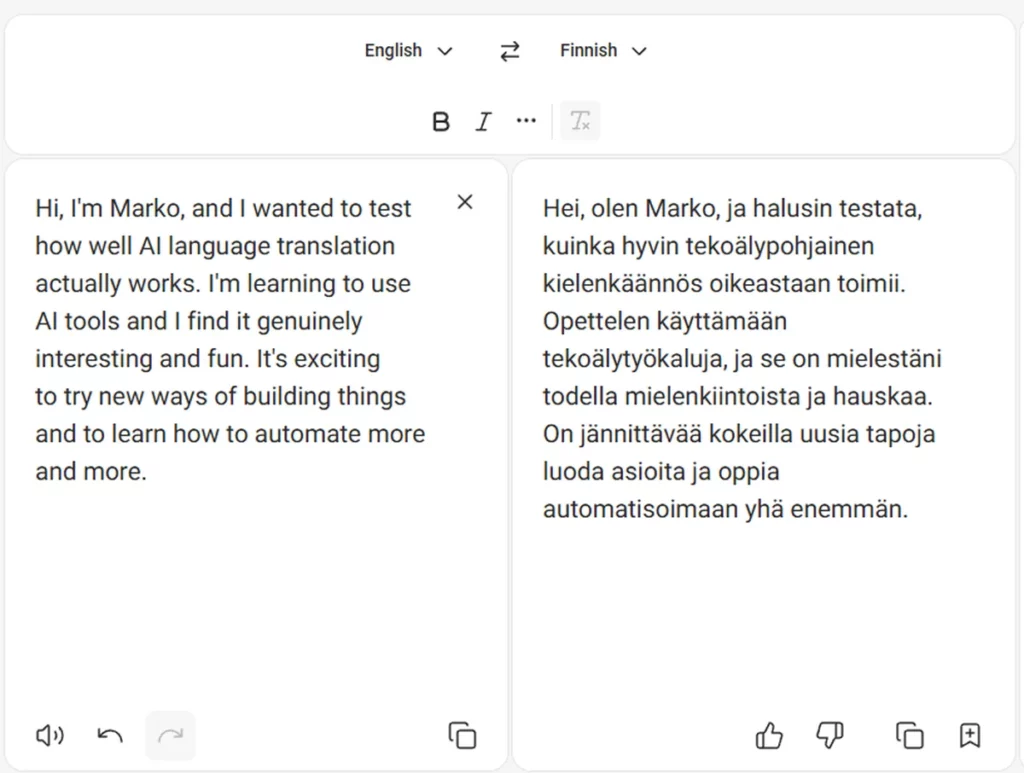
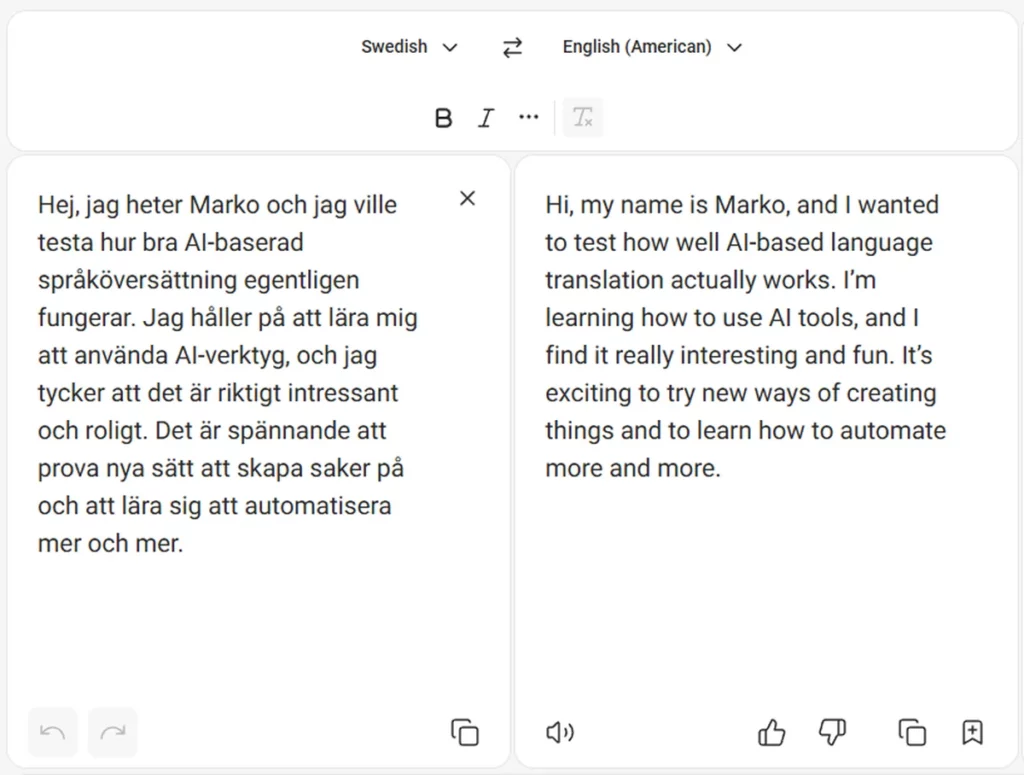
This surprised us. Across the first two stages, short text and the full 1000-word piece, all four tools produced translations that were, frankly, excellent. We tested into Finnish, Swedish, French, Estonian and more, and the output read naturally almost every time. Occasionally a word or two sounded slightly off, what we would call “wonky,” but nothing that took more than a moment to fix.
The honest takeaway is that modern AI translation for common European languages is essentially a solved problem for everyday use. You will not need to heavily rewrite what comes out. If your job is “turn this text into that language,” any of these four will serve you well, and you would struggle to pick a winner on quality alone.
English to Finnish:
Swedish to English:
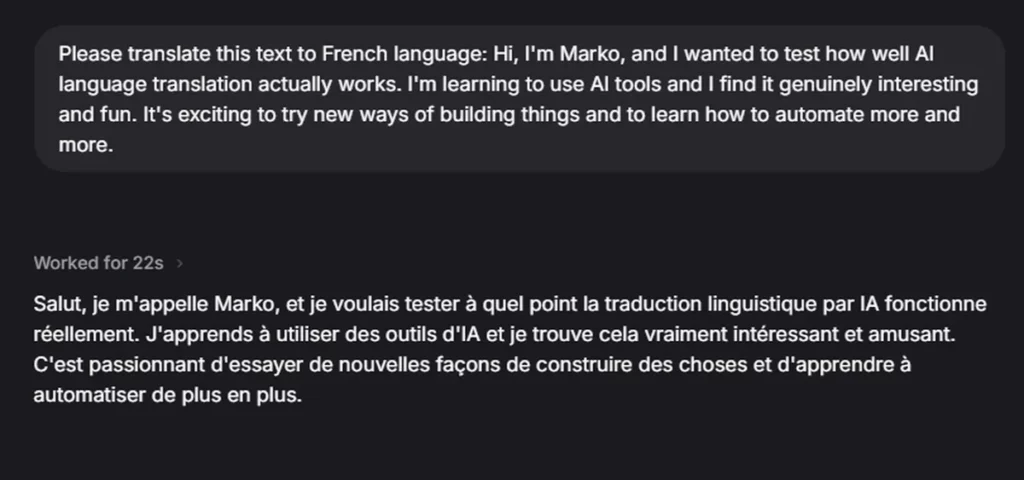
Gemini gave two options, which is cool.
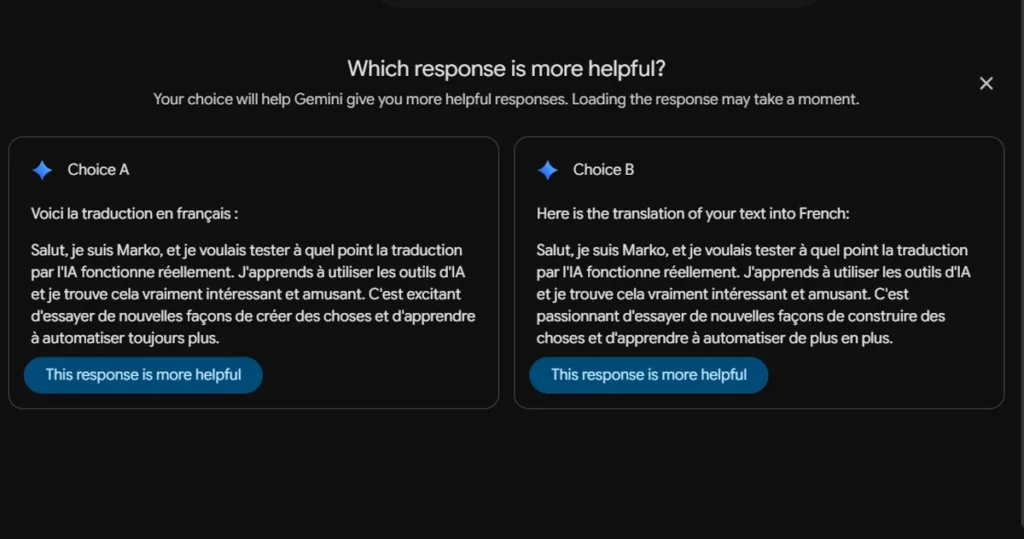
That is a genuinely useful thing to know, because it means the old question, “which translator is most accurate,” matters far less than it used to. Which raises a better question, and we will come back to it: if they are all this good, what should you actually choose on?
Finding 2: short original writing is great too
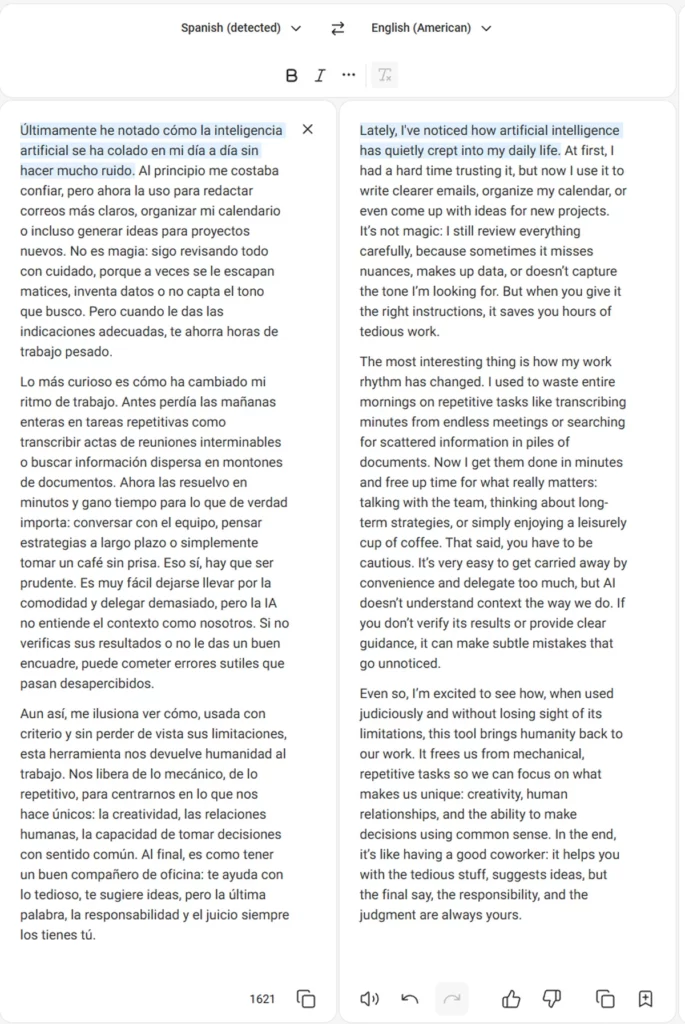
For the third stage, we asked each tool to write a short 250-word piece directly in the target language, not translated from English, but prompted from English to the Native fresh text. This is harder, because there is no source text to lean on. The tool has to actually write in the language.
Mistral.AI 250 word Spanish generated text:
Gemini 250 word Spanish generated text:
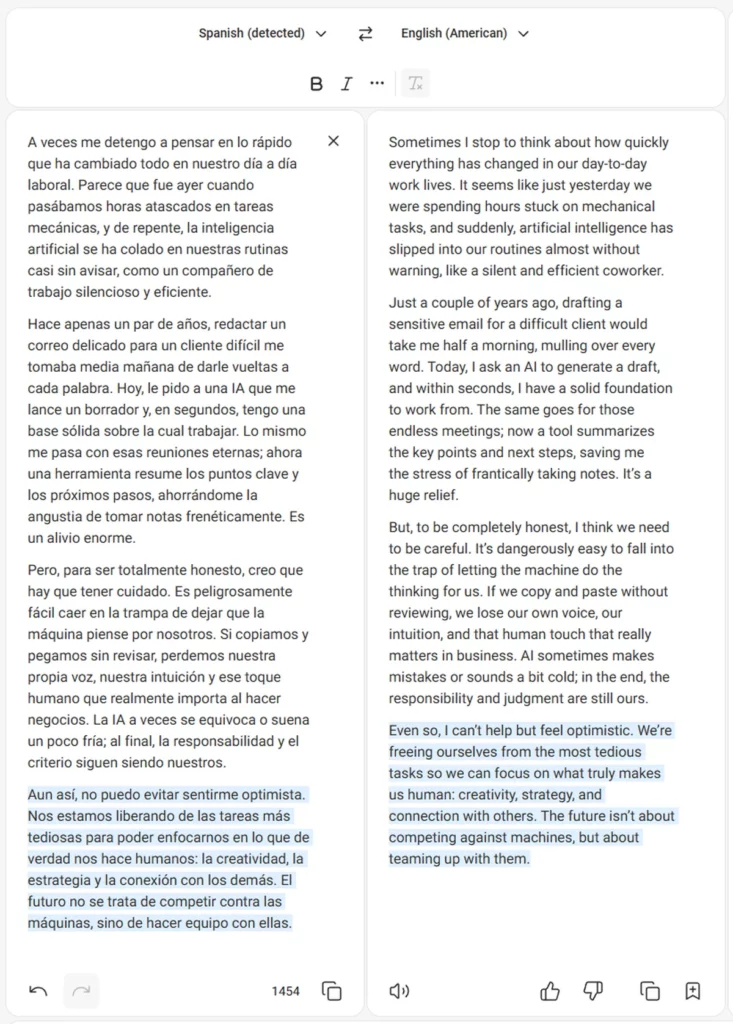
They handled it well. The short pieces came out natural and readable, and the better ones clearly wrote for a local reader rather than producing stiff, translated-sounding text. At this length, with a focused prompt, AI writing in European languages is genuinely good.
Finding 3: push it long, and they fall apart differently
This is where the test earned its keep. For the final stage, we asked for a long 2500-word piece from the same kind of prompt. And here the tools separated sharply.
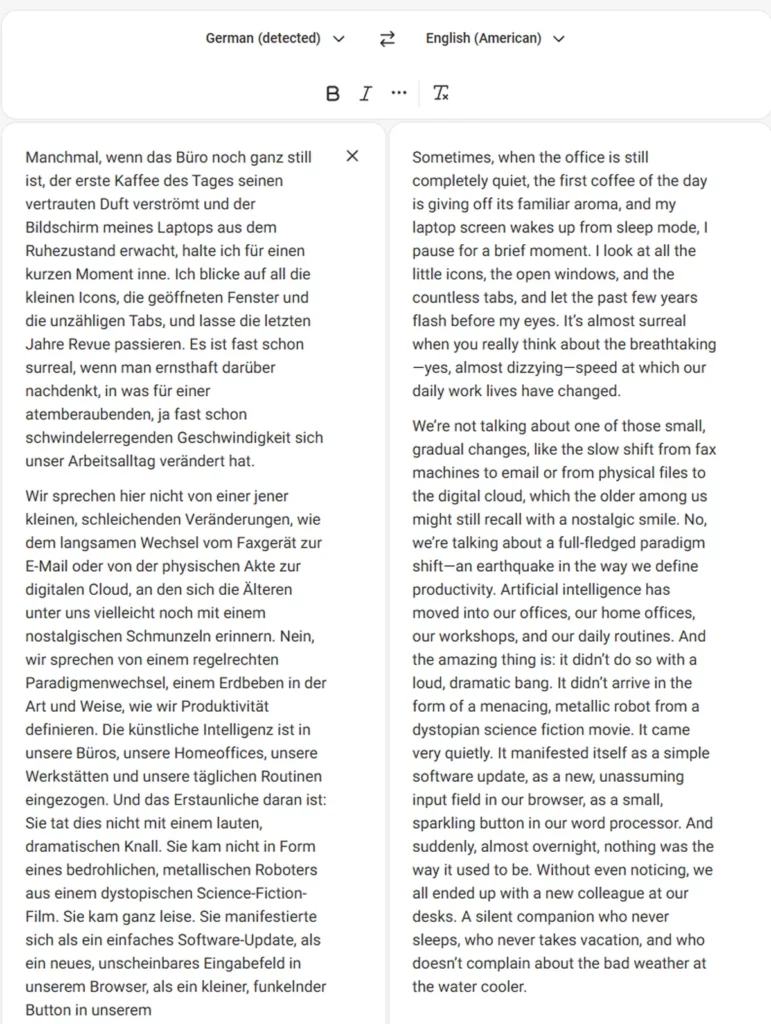
The core problem showed up clearly: when you ask for a lot of words but give a fairly general prompt, the tool runs out of real things to say long before it reaches the word count. So it starts to pad. It repeats itself, adds filler, states the obvious, and stretches thin material to fill space. In places it simply invents things to keep going. This is the “hallucination” people worry about, and it is most visible exactly here, in long text built from a thin brief.
Gemini struggled the most. Its long piece drifted into filler and slop, repeating ideas and padding to reach length, and it did not really write for a local reader. It was the weakest of the four at this task by a clear margin.
Mistral and ChatGPT held up better. They stayed more grounded, wrote more naturally for the reader, and padded less. They were not perfect, no tool is at that length from a thin prompt, but the difference was obvious.
Gemini part of the 2500 word article in German:
Mistral.AI part of the 2500 article in German:
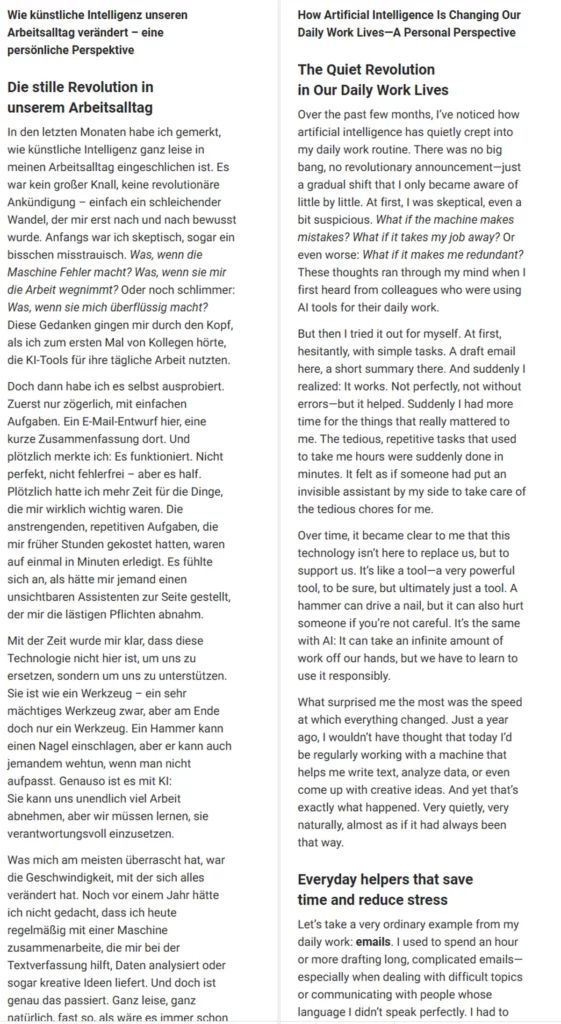
The honest lesson here is not “AI cannot write long text.” It is that you have to match the length to the substance you give it. Ask for 2500 words on a broad topic with no real material, and you will get padding, whichever tool you use, and some far worse than others. Give it real substance (your notes, your facts, your specifics) and keep your expectations sensible, and it stays useful. Translation held up over length because there was always a source anchoring it. Free generation drifts because there is nothing holding it down.
A fair note on Gemini, in the spirit of being even-handed: it translated just as well as the others in the first stages. Its weakness was specifically long-form original writing from a thin prompt. So this is not “Gemini is bad,” it is “Gemini was the weakest at one specific, demanding task.”
The real deciding factor: where does your text go?
Here is the point that follows from Finding 1. If all four translate beautifully, then quality is not the thing that should decide your choice. The thing that should is data, and this is where a European user should pay attention.
Every time you paste text into one of these tools, that text goes to the company behind it. For a shopping list, who cares. But if you are translating a client email, a contract, or anything with personal data in it, you have just sent that data somewhere, and where matters under GDPR. On this axis the four tools are not equal at all:
- Mistral is a French company, and it processes data in the EU by default. For keeping European data under European jurisdiction, it is the strongest of the four.
- DeepL is a German company with a genuinely strong data posture: it offers a data-processing agreement, is ISO 27001 certified, does not train on paid text, and deletes your text after translating it. One honest nuance for 2026: DeepL now uses a hybrid setup that includes AWS regions, and a contractual guarantee to keep data in a specific region is an add-on on its top tier. So it is an EU company with excellent practices, just check the plan detail if strict residency is a hard requirement.
- ChatGPT and Gemini are US companies. They can be used carefully, and their business tiers add protections, but on the consumer tiers your text is processed in the US, which is a cross-border transfer you have to account for.
So the recommendation writes itself, and it lands exactly where our whole site does: since quality is a tie, choose on sovereignty, and the European options (Mistral and DeepL) are the natural home for anything sensitive. For the fuller picture of where AI tools store European data, see our guide to AI tools with EU data residency, and for the specific case of putting data into ChatGPT, our guide on whether ChatGPT is GDPR compliant.
One important clarification: DeepL translates, it does not write
Worth knowing before you choose, because it trips people up. DeepL is a translation tool. It converts text you already have; it will not write you an original article from a prompt the way ChatGPT, Gemini or Mistral will. DeepL does have a second product, DeepL Write, but that is an editing assistant that improves grammar, tone and phrasing in text you have already written (currently strongest in English and German). It is a polisher, not a blank-page writer.
So the honest split is this. For translating existing text, DeepL is a specialist and one of the best. For writing original text in another language, the contenders are the chat AIs: ChatGPT, Mistral and Gemini. Comparing DeepL on free-form writing would be judging it on a job it was never built to do.
The tools, scored
Scores are our own assessment under our published methodology: a Sovereignty Score (where your data lives and how it is handled) and a Usability Score (how well it did the job in our testing).
DeepL 🇪🇺
The translation specialist, and it earns the reputation. Beautifully natural output for European languages, a clean and simple experience, and a strong data posture for a European business. Best for: anyone whose main job is translating existing text and who cares about data handling. Worth knowing: it does not generate original text, and strict data residency is a top-tier add-on. Free tier available; Pro from around 9 euros a month. Great tool for translating, BUT not text creation (that’s why less points!) Sovereignty 8/10 · Usability 9/10(Translating text, not generating)
Mistral 🇪🇺
The European all-rounder and the sovereignty pick. It both translates and writes, its European-language quality is genuinely strong, and it processes data in the EU by default, which none of the US tools can match. Best for: European users who want one EU-based tool for both translating and writing. Worth knowing: the interface and ecosystem are less polished than the US giants, and the context window is smaller. Free tier (Le Chat); Pro around 17.99€ a month. Sovereignty 10/10 · Usability 9/10
ChatGPT 🇺🇸
The strong generalist. Excellent at both translating and writing, with good control over tone and register, and it held up well even in our long-generation test. Best for: people who already use it and want one tool for everything. Worth knowing: it is US-based, so mind the data question for anything sensitive (see our ChatGPT GDPR guide). Free tier; Plus around 23 euros a month. Sovereignty 3/10 · Usability 9/10
Gemini 🇺🇸
A capable translator that stumbled on the hard task. It translated as well as the others in our first stages, but its long-form original writing drifted into filler and padding, the weakest of the four at that job. Best for: quick translation, especially if you live in Google’s tools. Worth knowing: US-based, and we would not reach for it first for long original writing. Free tier; paid plan around 22-23 euros a month. Sovereignty 3/10 · Usability 6/10
At a glance
| Tool | From | EU data by default | Translates | Writes original text | In our test | Sovereignty | Usability |
|---|---|---|---|---|---|---|---|
| DeepL 🇪🇺 | Germany | Strong (see plan) | Yes | No (Write = editing only) | Excellent translation | 8/10 | 9/10 |
| Mistral 🇪🇺 | France | Yes, by default | Yes | Yes | Strong all round | 10/10 | 9/10 |
| ChatGPT 🇺🇸 | US | No (US) | Yes | Yes | Strong all round | 3/10 | 9/10 |
| Gemini 🇺🇸 | US | No (US) | Yes | Yes | Weak at long writing | 3/10 | 6/10 |
Scores are our own assessment, not vendor claims. Prices and plans change often; check current rates.
So which should you choose?
- If you mostly translate existing text: DeepL is the specialist and a joy to use, with a strong data posture. Mistral is the best European alternative if you also want to write.
- If you want one European tool for both translating and writing: Mistral. It is the sovereignty pick and genuinely good across the board.
- If you already live in ChatGPT and want one tool for everything: ChatGPT is excellent, just mind the US data question for sensitive material.
- If data must stay in the EU: Mistral by default, or DeepL with the right plan. Not the US tools for sensitive personal data.
- For quick, throwaway translation: honestly, any of them. They are all good enough now that convenience wins.
The real headline, though, is the one from our testing: for translation, quality is no longer the thing that separates these tools. They are all excellent. So choose on the thing that still differs, which is where your data goes, and for a European handling real data, that points home.
Frequently asked questions
Which AI translates European languages best? In our testing, DeepL, ChatGPT, Gemini and Mistral all translated European languages excellently, with only tiny differences. For everyday text you can use any of them, so we would choose on data handling rather than quality, which favours the European tools (Mistral, DeepL).
Is DeepL better than Google Translate? For European languages, DeepL is widely regarded as more natural, and that matches our experience. But the gap has narrowed as all these tools have improved. DeepL’s bigger advantages for a European business are its data posture and its polish.
Can DeepL write text for me, not just translate? Not in the way ChatGPT can. DeepL translates existing text. Its DeepL Write product improves and rephrases text you have already written, but it does not compose original text from a prompt. For that, use a chat AI like ChatGPT or Mistral.
Is it safe under GDPR to paste business text into a translator? It depends where the tool processes your data. Pasting text sends it to that company, so for personal or business data, a tool that processes in the EU (Mistral by default, DeepL as an EU company) is a safer starting point than a US tool on a consumer plan. See our EU data residency guide.
Which is the best European AI translation tool? Mistral (France) for an all-rounder that translates and writes with EU data residency by default, and DeepL (Germany) for translation specifically. Both keep you on firmer GDPR ground than the US options.
Do AI tools write long articles well? Short pieces, yes. In our test, long original pieces (2500 words) from a general prompt drifted into filler and repetition, and one tool invented material to fill space. The fix is to give the tool real substance to work with rather than expecting length from a thin prompt, and to check long AI-written text carefully.
The honest summary
We expected this to be a contest for the best translator. Instead we found that translation is basically solved: DeepL, ChatGPT, Gemini and Mistral all handle European languages so well that quality barely separates them for everyday work. That flips the real question from “which is most accurate” to “where does my data go,” and for a European user handling anything sensitive, that points to the EU-based tools, Mistral by default and DeepL as a strong German option. Writing original text is a different job: fine when short, but it drifts into filler when you push it long from a thin prompt, and there the tools genuinely differ. Translate with confidence, write with a shorter leash, and choose your tool on data rather than on a quality gap that no longer really exists.
Sources
- DeepL is a German company (Cologne, founded 2017); offers a GDPR data-processing agreement, ISO 27001 and SOC 2 certification, does not train on Pro text, and deletes text after translation; moved to a hybrid AWS model (EU/US/JP) in January 2026 with regional data residency as an add-on. DeepL, Security and privacy: https://www.deepl.com/en/pro-data-security
- DeepL Write is a writing assistant that refines grammar, tone and phrasing (not an original-text generator), strongest in English and German. DeepL, DeepL Write: https://www.deepl.com/en/write
- Mistral is a French company processing data in the EU by default; Le Chat offers a free tier and a Pro plan; strong European-language quality. Mistral AI: https://mistral.ai/
- OpenAI (ChatGPT) and Google (Gemini) are US companies; consumer-tier data is processed in the US. See our linked guides on EU data residency and ChatGPT GDPR compliance for the detail.
- https://euroaiguide.com/ai-tools-with-eu-data-residency-what-european-businesses-can-actually-use/
- https://euroaiguide.com/is-chatgpt-gdpr-compliant-an-honest-guide-for-european-businesses/
Last reviewed 28 July 2026. A hands-on test from a European user, not a lab benchmark; results vary by language and task. Pricing, plans and data terms change, and we update this guide as they do.